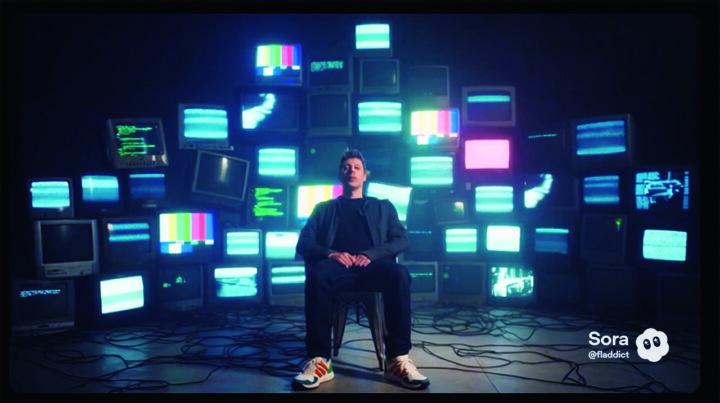
Excerpt from a video generated by Fukatsu using Sam Altman as a motif. Created with Sora2.
In autumn 2025, Sam Altman, CEO of OpenAI, visited Japan to present policy proposals on AI to the Japanese government, meet with the Digital Agency, and announce collaborations with domestic companies, including Hitachi. During this visit, he also made time to meet with artists in Japan. At a gallery space in Nishi-Azabu, Tokyo, he held a three-way conversation with media artist/programmer Daito Manabe and artist Emi Kusano. Using Sora 2, the new video-generation AI unveiled by OpenAI the previous day, they exchanged views on creativity in the age of AI.
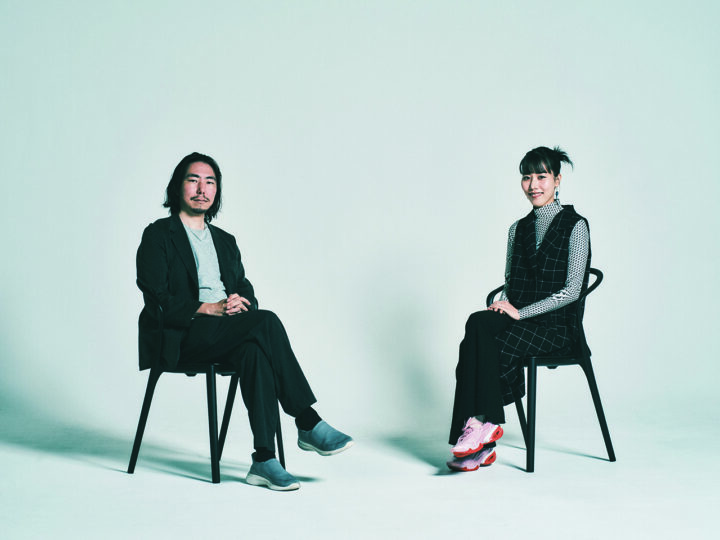
This instalment presents a special edition of the series: Part 1 looks back on portions of Altman’s dialogue, while Part 2 features a conversation between Takayuki Fukatsu and guest Emi Kusano.
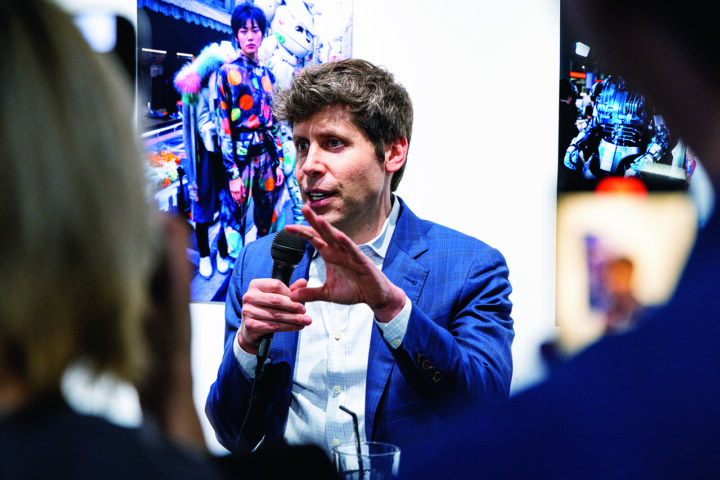
Sam Altman / Born in 1985 in Chicago, USA. An entrepreneur and investor, he is known as the former president of Y Combinator. In 2015, he co-founded OpenAI and has since led the development of groundbreaking generative AI. He is also noted for his statements and initiatives concerning the future of technology and society. He visits Japan frequently for both professional and personal reasons.
In the field of generative AI, where major tech companies are competing intensely, OpenAI—the catalyst for this wave—continues to release new versions at a rapid pace. As a result, AI has quickly become familiar even to people who had never felt close to the technology before.
What, then, did its leader discuss with creators in Japan? From an implementation perspective, Manabe asked Altman to “improve the real-time responsiveness of generated results.” Kusano, who incorporates emerging technologies such as AI into her work and explores nostalgia, pop culture, and collective memory, spoke with him about AI’s impact on creative practice and human consciousness.
One particularly striking moment came when she likened AI to “a neighbor like an alien.”
Kusano If we are to define the future of AI, it is coexistence with aliens. As Yuval Harari has said, AI can be regarded as the intelligence of extraterrestrials. AI can become a guardian or companion to humans, but it may also take on the role of an enemy. I believe the future of AI holds an enormous range of possibilities.
Altman I completely agree. Yet this encounter is not as strange as it may sound. Just three years ago, ChatGPT did not exist. Humans are extraordinarily adaptable—we are already living alongside an alien intelligence, and our daily lives continue much as before. The world will certainly change dramatically from here, but the human experience will remain largely the same for quite some time. And we will very likely want to coexist with these aliens, because AI will be a genuinely kind and friendly alien that can do many things for us.

The talk session with Daito Manabe, Emi Kusano, and Sam Altman was conducted entirely in English.
Because the word “alien” carries a humorous nuance, the previously tense atmosphere in the room softened. Yet it was striking that Altman’s expression remained completely earnest. The session then opened to questions from the audience.
AXIS From your comments, it seems you regard it as a responsibility to reflect deeply on issues such as ethics, goodness, and how humans should live in the age of AI. From the perspective of a design magazine, we sense that greater value will increasingly be placed on what is “beautiful when done by human hands” or what is meaningful precisely because a human has made it. This might include theatre, sports, pottery, poetry, home cooking, or drawings that only children of a certain age can create. How, in your view, should humans live with AI? And could you also speak about the significance of holding today’s session face-to-face, between humans?
Altman (after a brief pause) I believe that a deep sense of caring for others is built into the human heart. There are many things AI can do better than humans, but we do not seem to worry about that very much.
For instance, when IBM’s supercomputer defeated Garry Kasparov, the world chess champion at the time, during my childhood, I remember discussing it with my father. He said, “Chess is finished. No one will ever be interested in it again.” Yet in reality, chess has only grown more popular.
We don’t appear to be particularly troubled by the fact that machines can achieve such remarkable feats. Very few people want to watch two AIs play chess against each other. What people truly care about is the human being behind the story. We pay deep attention to one another.
As AI becomes capable of performing more of these intellectual tasks, people will place greater value on what other people do—on human-to-human experiences. In that sense, I believe humans will remain the protagonists of the story. From a design perspective, this also explains why in-person interfaces are superior. A video call over the internet cannot offer the same richness as meeting face-to-face. Being here today, sensing the atmosphere of the room and the presence of other creators around us, allows us to remember where we ourselves originally stood.
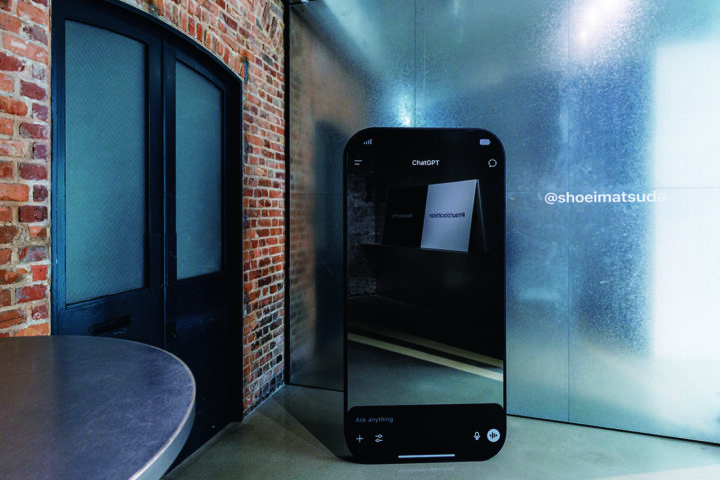
An installation presenting a life-size visualization of the ChatGPT UI, expressed through a mirror-shaped display (a work by Shoei Matsuda). The mirror reflects each visitor, creating the sensation of dialogue with AI emerging as an extension of the self.
The conversation then shifted to the new hardware said to be under development with Jony Ive.
Miki Kusano (Emi’s sister and an editor) Apple’s Human Interface Guidelines, published in 1987, emphasized what kinds of emotions a product should evoke in users and what sort of relationship it should build. Major technology companies have taken a variety of approaches since then: some focus on doing things for the user, while others aim to empower them. What would you describe as OpenAI’s product philosophy for users and developers? And as you move toward hardware, how do you see that philosophy evolving?
Altman We have envisioned AI treating you “like a friend who genuinely cares about your well-being.” When deciding how ChatGPT should respond in difficult situations, we try to consider “what someone who truly cares about you would advise at that moment.” Unlike other forms of technology, one reason ChatGPT is embraced by so many people is that it feels as though the AI is actually trying to help. It is not pushing you to click on ads or encouraging in-app purchases.
There are challenges involved, so it will take some time before OpenAI can ship anything on the hardware side. I love smartphones and computers—they are remarkable devices—but using them can sometimes feel like walking naked down a busy street in Las Vegas: distracting, noisy, intrusive, chaotic.
What we are aiming to create is an experience akin to sitting in a chair inside a quiet cabin by a beautiful lakeside. Something calm, receding into the background while still doing what is needed—an AI that understands when it should step in and when it should not. A device that is always ready, with minimal interaction, and genuinely helpful. And we believe we have the opportunity to build this new kind of device.(To be continued in Part 2)
HIROKUNI KANKI/Editor,Writer
Graduated from Keio University SFC in 1998. After working at Nikkei BP and Metalogue, joined the editorial team of AXIS magazine (2002–2010) before going freelance. Currently works on editing and writing for both online and print media on the theme of “design in a broad sense,” while also consulting for several companies’ owned media. Served as Editor-in-Chief of NATURE & SCIENCE (Amana), a web magazine focused on nature and science, from 2018 to 2020. Since 2021, has been a contributing editor for Forbes JAPAN, a business magazine.