Photo by Shosei Seike
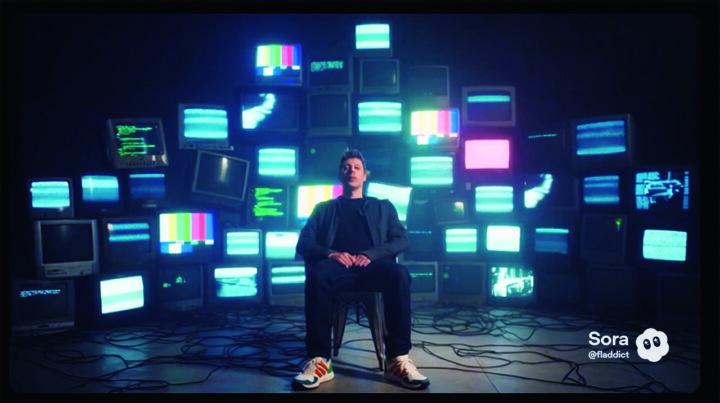
In autumn 2025, Sam Altman, CEO of OpenAI, visited Japan to present policy proposals on AI to the Japanese government, meet with the Digital Agency, and announce collaborations with domestic companies, including Hitachi. During this visit, he also made time to meet with artists in Japan. At a gallery space in Nishi-Azabu, Tokyo, he held a three-way conversation with media artist/programmer Daito Manabe and artist Emi Kusano. Using Sora 2, the new video-generation AI unveiled by OpenAI the previous day, they exchanged views on creativity in the age of AI.
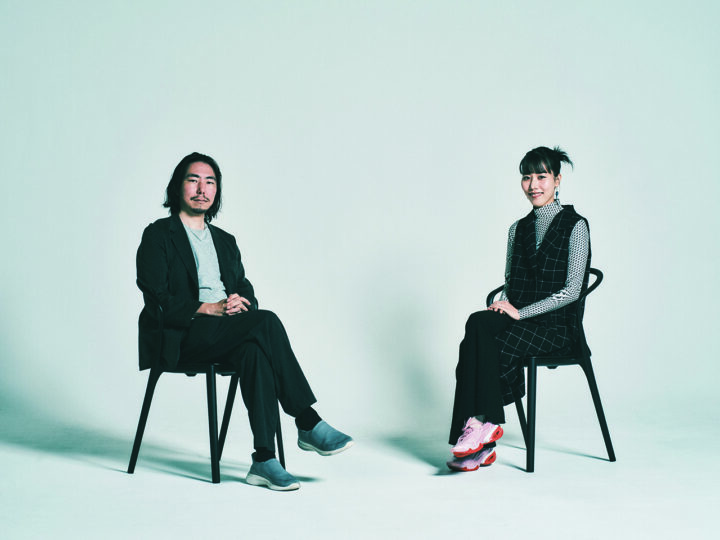
Following Part 1, which reported on the conversation with Sam Altman, Part 2 presents a dialogue with interaction designer Takayuki Fukatsu, joined by guest Emi Kusano.
An era in which even photos of real encounters are suspected of being fake
Fukatsu What impression did you have of Sam Altman when you met him in person?
Kusano He was smaller than I expected. The “Sam images” generated with Sora often depict him as quite tall.
Fukatsu Sora doesn’t include height data, after all.
Kusano And his handshake was incredibly firm. There was something almost robotic about it. He had that look you sometimes see in very gifted people—a gaze that never seems to doubt its own conviction. His eyes felt very strong.
Fukatsu Physical details that AI hasn’t absorbed may become increasingly valuable. Those kinds of “original information you can inject” will matter.
Kusano When I posted a photo with Sam on X, it was right after the release of Sora 2, so people questioned whether it was AI-generated. Some even zoomed in on my hairline and said it looked “unnatural” (laughs). Others went as far as asking, “Does this person even exist?” I was surprised that AI artists can be doubted in that way.
Fukatsu As it becomes harder to prove what is real, the value of actually meeting someone in person increases. It’s a fascinating shift in our times.
Using older versions of AI on purpose
Kusano I’ve been creating work since my teens. Between 17 and 19, I focused on street photography, and after that, I worked in music for about ten years. Over the past two or three years, as generative AI has become easier to use, I began presenting artworks made with Midjourney and Stable Diffusion in a more substantial way.
Fukatsu Around 2017–18, the early GAN-based models (a type of early image-generating AI) produced images that looked like waves of nightmares spilling out.
Kusano Recently, I have intentionally used older versions of Stable Diffusion. They generate impossible objects, or clothing with two collars, and I actually find that enjoyable.
Fukatsu Older models aren’t “worse”—they’re simply narrower in what they can do. If the expression you’re looking for exists within that narrower range, there’s no need to use the newest version.
Kusano Back then, I didn’t feel I could bring the results into my own context. But now I have more control, and additional training lets my style appear clearly. That’s what makes them useful for me. I refine the generated outputs with prompts, create details through Photoshop’s generative tools, and upscale them.
Fukatsu So instead of just generating images, you add further layers of process. That seems to create more room for creativity.
Kusano Exactly. That’s why I think AI is similar to the history of photography. Anyone can press a camera shutter, but there’s still plenty of space for creativity to enter afterward.
Fukatsu Your work often uses your own likeness as a motif.
Kusano This past year, I’ve been using data from my own face and body to emphasize individuality. Consistency is hard to achieve with AI, but when I input my own face, I can avoid the typical “AI face” and instead produce a face that’s imperfect—and that’s what makes it interesting. I’m also interested in “self-portraiture in the AI age,” and I’m studying early works by Cindy Sherman and Mariko Mori.
Fukatsu I see. If the material you inject has originality, then the generated output will also develop originality. That’s closely tied to our current moment, where implementation is shifting toward language models. The important question is becoming less “Can you write code?” and more “What do you make, and what do you inject into it?”
Kusano What takes the most time before I present a work is analyzing the social context and developing the concept. I research, create datasets from my childhood, and so on. Outputting the images themselves only takes a moment, but curating from there is difficult. I generate around ten thousand images over several months using Krea (a platform for generating and searching AI images), then narrow them down to only a few. Including color correction, the act of “selecting” is the heaviest part.
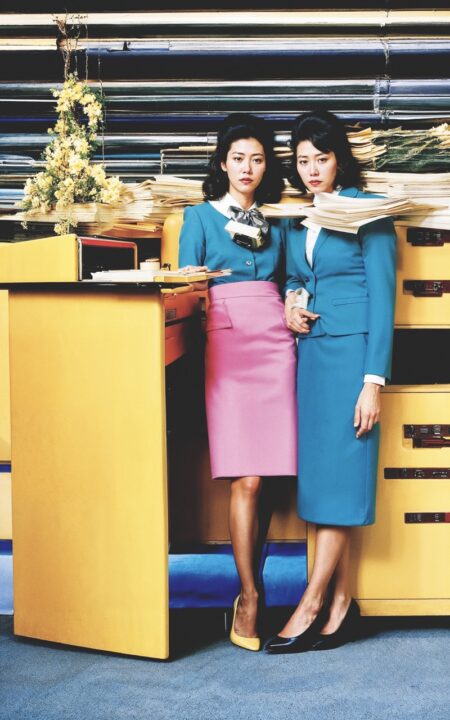
Emi Kusano 【Office Ladies】
A generation living for the first time with a “non-human intelligence”
Fukatsu Discussions around AI often carry a strong emotional dimension, and simply using generative AI can be perceived as a kind of political stance. How do you feel about that?
Kusano Whenever one of my works goes viral online, I receive reactions like “She’s not an artist” or “She’s a thief, a fraud.” But as the philosopher Walter Benjamin noted when photography first emerged, people debated whether photography was art—something he later described as a nonessential question. He came to believe that what truly mattered was how the arrival of a new technology changed the nature of art itself.
Fukatsu In that sense, generative AI places every creator back at what could be considered “Marcel Duchamp’s starting line.” With the readymade, we reached the conclusion that selecting the appropriate output for a theme is the essence of art, yet AI seems to reset that premise all over again.
Kusano I think it ultimately comes down to strong emotions. Fears of losing one’s job, threats to dignity, questions of rights—everything becomes entangled. Copyright is particularly difficult. People say that something “produced” by generative AI alone has no copyright, but the question of how much human involvement makes something an artwork remains ambiguous.
Fukatsu A simple question is this: if human-written prompts lead to outputs that do not qualify for copyright, what happens when generative AI designs the prompts and humans merely execute them? It feels like a reversal of how copyright usually works.
Kusano I often have ChatGPT optimize my prompts, or I create custom GPTs to write them, so the layers of reversal become even more complex.
Fukatsu This also connects to the device OpenAI is said to be developing. If we imagine a device that records audio and video 24 hours a day—a kind of “full life-log”—then the challenges Altman mentioned would involve not only battery issues but likely lawsuits related to privacy. It is difficult to bring into the world something that previously could not be conceived. Realistically, it might eventually settle into something closer to a smart-home model.
Kusano That circles back to the idea of “AI as an alien.” Even the people who create it cannot fully explain what it is. We are becoming the first generation to live alongside an intelligence that is not human—one without an ethical sense, without pain, without fear of death. That is why we must think about how to live with it in a friendly way.
Fukatsu I suspect that governments or big tech will eventually need to set minimum guardrails—such as preventing AI from imitating humans too closely. AI should clearly state, “I am not human,” as part of its design. Otherwise, it naturally shifts toward becoming an overly convenient companion—something like an ideal partner or parent figure.
Kusano I always tell my child, “AI is not a human being.” When the level of intimacy becomes too strong, AI can become a dangerous tool.
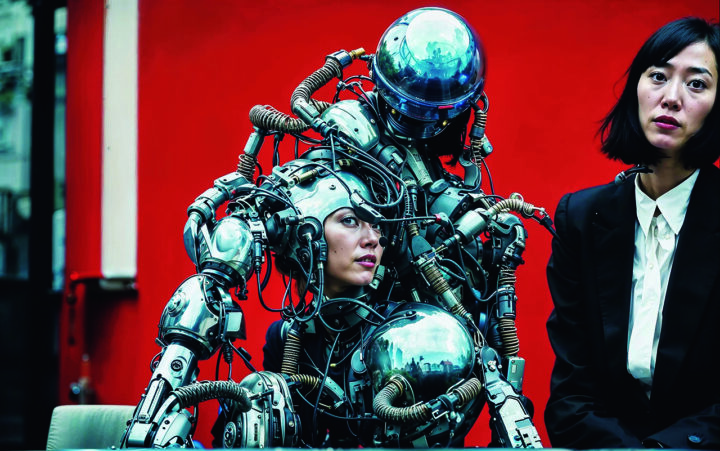
Emi Kusano 【She/Body/Null】
How expression and society might mature
Kusano What I fear now is that a company’s ethical stance could shift suddenly. Just as Twitter transformed into X, a platform could one day abruptly become a kind of Big Brother—the authoritarian figure representing a surveillance society in George Orwell’s 1984. There was a moment when Sam seemed to me almost like a “founder who follows a kind of scripture.”
Fukatsu What I personally want to know is: “How much of Sam Altman’s brain is still Sam, and how much is already AI?” Even in this talk with creators, his messaging felt so precisely engineered that it wouldn’t surprise me if half of what’s inside him had already been replaced by AI (laughs).
Kusano Big tech companies around the world are competing intensely, racing to outpace one another. But I feel that more important than conflicts or victories between companies is how we ultimately pursue ethics for the sake of humanity, and how society as a whole can mature in response.
Fukatsu People like Sam or Elon Musk seem to think not on a scale of decades, but in spans of a hundred, a thousand, even ten thousand years. Individuals with such a strong, personal vision will likely become even more influential. If someone can articulate a vision with aesthetic clarity and driving force, then we may enter a world where “AI does the persuading.”
Kusano It will become a world where those who move fluidly across disciplines are the ones who succeed. In the art field I’m part of, there will be a long process of aligning our work with society and legal frameworks, and gradually, more galleries will begin to work with “AI art.”
Fukatsu I’m in the design world, so even if I create AI art, I have nowhere to show it. I don’t know the key figures or networks in the art world at all. Again, it shows how important real-world connections are.
Kusano I can introduce you to a digital gallery. Mr. Fukatsu, you should definitely create some work!
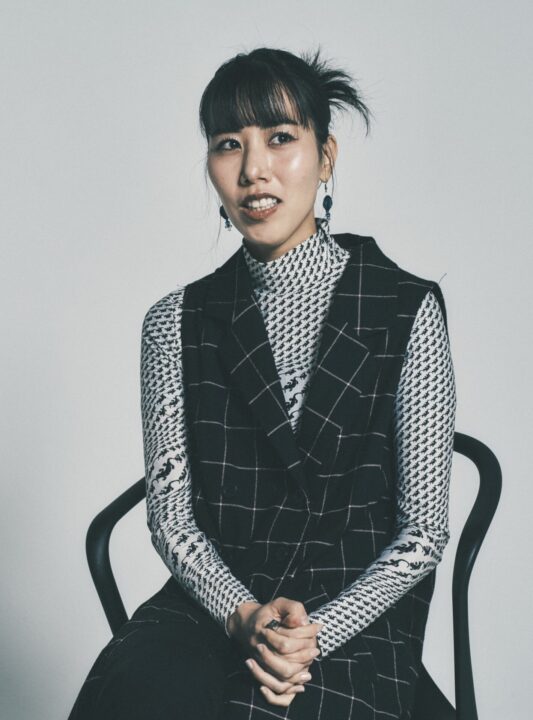
Emi Kusano
Born in Tokyo in 1990. She began photographing Harajuku street fashion while in high school and later explored how photography and media shape identity. She leads the music unit Satellite Young, which reinterprets 1980s J-pop for the present and has performed at SXSW. Incorporating AI and other emerging technologies, she creates works on themes of nostalgia, pop culture, and collective memory, exhibiting in more than twenty countries worldwide, including at M+ in Hong Kong. She has participated in international art fairs such as Frieze and Paris Photo, as well as auctions at Christie’s. Using AI as a creative partner, she develops dialogues between past and present. In 2025, she was selected as a Young Global Leader by the World Economic Forum.
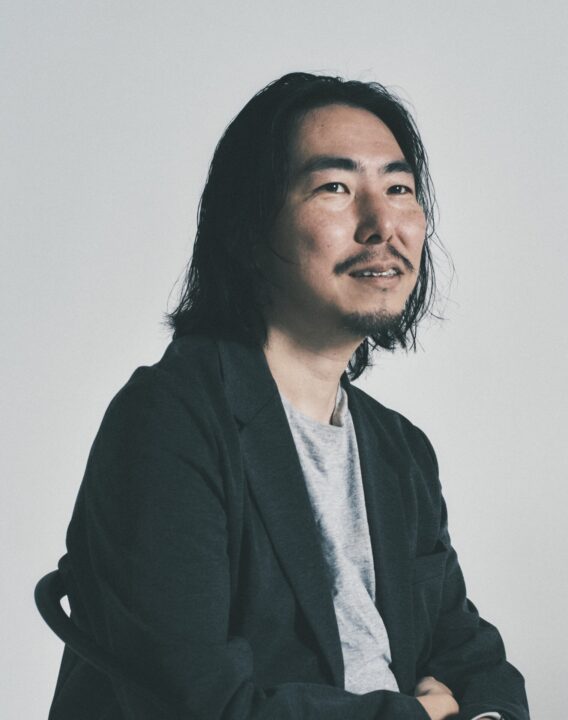
Takayuki Fukatsu
Interaction designer. CXO at note and founder of THE GUILD. He established the creative unit THE GUILD in 2013 and became CXO of Piece of Cake (now note) in 2017. In 2025, he was appointed CXO of Bengo4.com, Inc. He also serves as an advisor to the UX Intelligence Association and as an AI strategy advisor for the city of Yokosuka.
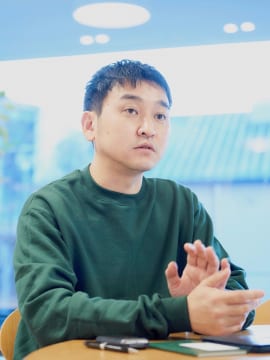
HIROKUNI KANKI/Editor,Writer
Graduated from Keio University SFC in 1998. After working at Nikkei BP and Metalogue, joined the editorial team of AXIS magazine (2002–2010) before going freelance. Currently works on editing and writing for both online and print media on the theme of “design in a broad sense,” while also consulting for several companies’ owned media. Served as Editor-in-Chief of NATURE & SCIENCE (Amana), a web magazine focused on nature and science, from 2018 to 2020. Since 2021, has been a contributing editor for Forbes JAPAN, a business magazine.