The Main Award winners and the representative of the Seoul Design Foundation, on stage. ©Seoul Design Foundation
With 941 submissions from more than 74 countries, the Seoul Design Award 2025 has emerged as a platform that foregrounds not aesthetic refinement alone, but also the social impact and real-world applicability of design in everyday life. As an international award that evaluates how localized challenges can be translated into universally resonant values, it showcases initiatives that bridge regional issues with global relevance. The awarded projects present concrete responses—through the lens of design—to some of the most pressing questions of our time, including the climate crisis, social inequality, and access to essential resources such as water and energy.
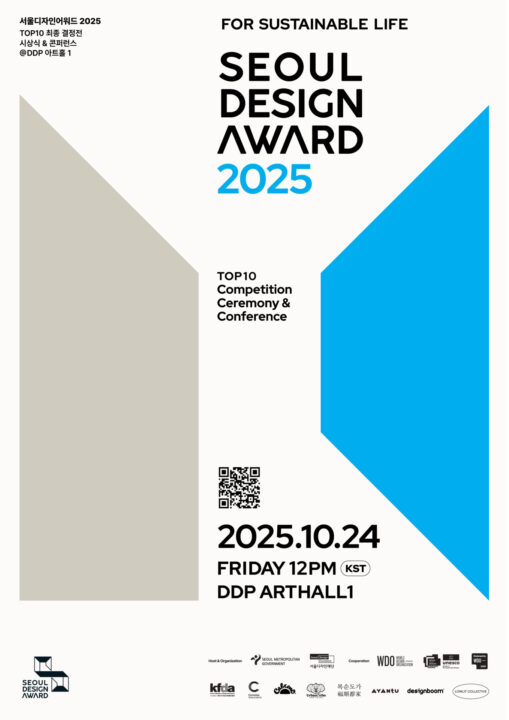
The official poster for the award prominently features the motto ‘For Sustainable Life.’ ©Seoul Design Foundation
In the contemporary design discourse, the priority has shifted from aesthetic excellence alone toward the discipline’s broader social utility and its imperative for sustainability. Against this backdrop, the Seoul Metropolitan Government, having long leveraged design as a strategic tool for problem-solving, inaugurated the Seoul Design Award in 2019 to spotlight exemplary sustainable design projects worldwide. It serves as a vital platform, honoring the designers, organizations, and companies that deliver inventive solutions to societal issues and, critically, foster harmonious and lasting relationships between humanity and the environment. Cha Kang-heui, CEO of the Seoul Design Foundation, its organizer, illuminates the distinctive mission: “Since being designated a City of Design by the UNESCO Creative Cities Network in 2010, Seoul has continuously prepared for a sustainable future by means of ‘design,’ often via inter-city collaboration.” Cha further clarifies the award’s defining distinction: “While conventional design competitions center on aesthetic quality, technological innovation, or market competitiveness, the Seoul Design Award places precedence on social value and responsibility, measuring the tangible influence of design on quotidian life. This emphasis compels design professionals to fundamentally re-examine the question: “What is the pivotal objective of design?”

Cha Kang-heui during the jury tea reception. ©Seoul Design Foundation
Guided by this overarching philosophy, the Seoul Design Award operates under a thematic structure comprising four categories: Health and Peace, Equal Opportunities (Universal Design), Energy and Environment (Upcycling and Recycling), and Cities & Communities. It maintains a radically inclusive submission policy, accepting projects published within the past five years. Its scope spans the full spectrum of design fields—from product and visual to digital and multimedia; space and system; service and experiential; and social design. Cha Kang-heui emphasizes the deliberate necessity behind such widespread eligibility. “Sustainability cannot be realized solely by the efforts of any single entity. Independent designers, nascent startups, major corporations, and civic organizations should all serve as partners aligned toward a shared goal. In this context, the award functions as an essential nexus that dismantles boundaries. All entries are evaluated against the criterion of effecting meaningful change. The commitment to diversity is the essence of the initiative, creating synergy by bringing together disparate stakeholders to co-create solutions with a transformative societal impact.

A visitor examined the Emergency Folding Cradle by Anako, one of the Top 10 entries, within the award’s dedicated exhibition space. ©Seoul Design Foundation
The annual event assembles a distinguished group of design experts, carefully selecting members who prioritize not only technical expertise but also empathy and acute civic sensitivity. This year, 32 leaders from over 20 nations participated, culminating in a 13-member final jury. It comprised Pradyumna Vyas, president of the World Design Organization; Andrea Cancellato, director of the ADI Design Museum in Italy; Ezio Manzini, president of DESIS Network and honorary professor of Politecnico di Milano; Dawn Lim, executive director of the Design Singapore Council; and Tanaka Kazuo, president and CEO of GK Design Group Inc., and executive advisor of the Japan Industrial Design Association. In addition, the panel of preliminary judges notably featured Esaka Eriko, program director of the Nagoya UNESCO City of Design Organizing Committee and councilor of the International Design Center NAGOYA. The award is divided into two primary categories: the Main Award, which recognizes concrete, user-ready products or projects; and the Concept Award, which targets mockups, prototypes, or plans that embody groundbreaking ideas. The evaluation for both subdivisions is premised on four screening criteria: first, Everyday Problems; second, Creative Solution; third, Social Impact; and fourth, Vision for the Future. A fifth criterion is applied exclusively to the Concept Award submissions: Feasibility of Design Concept: Does the concept propose a feasible method of realization, gauged by the expected user experience?
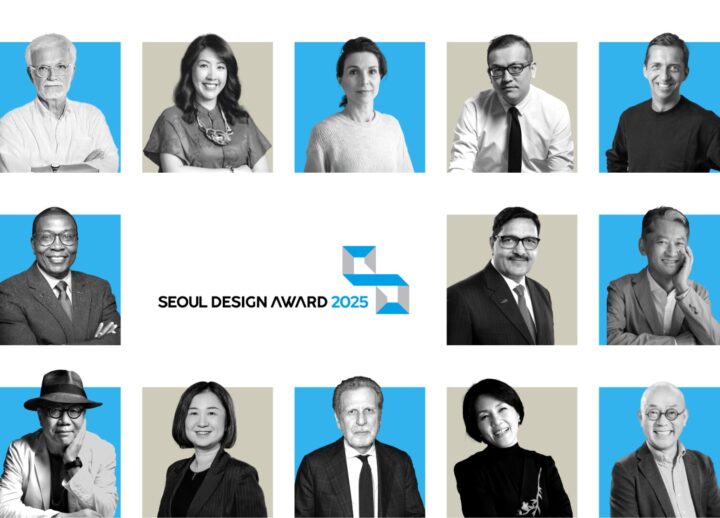
The final jury panel, composed of thirteen globally renowned design leaders. ©Seoul Design Foundation
The spirit of mutual value discovery and cooperative ethos is centrally embodied within its selection process, known as Live Judging. The ten finalists, having successfully cleared the earlier evaluation rounds, demonstrate their proposals via a universally accessible live stream of the presentations. This unique judging procedure actively engages both the on-site jury and the community of design enthusiasts, facilitated by real-time voting, thereby effectively cultivating a dynamic dialogue that deepens the understanding and discussion surrounding the design outcomes. Consequently, design surpasses the confines of expert critique, establishing itself as a communal festival where citizens share these inherent values, promoting a sustainable urban culture built on extensive involvement. Reflecting its international scope, 941 submissions were received from 74 countries for this edition. The 6th Seoul Design Award 2025 Grand Prize Final Round and Award Ceremony, along with the International Conference on Sustainable Design, culminated at the Dongdaemun Design Plaza on the 24th of October.
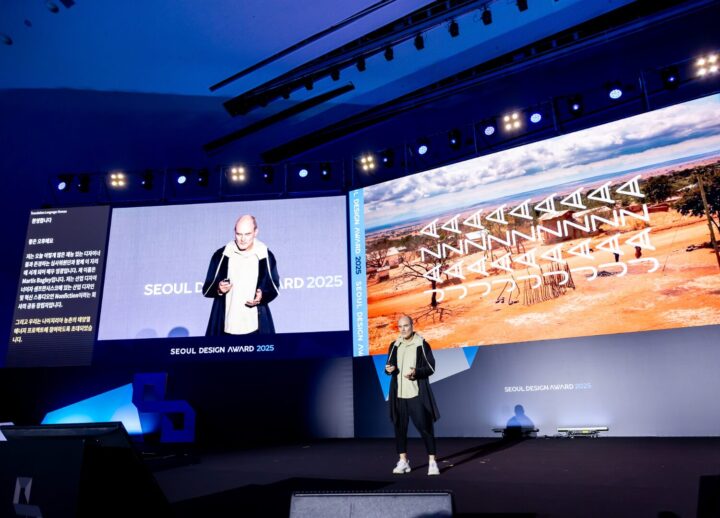
The live presentation featured a real-time voting system, allowing design enthusiasts worldwide to participate simultaneously. ©Seoul Design Foundation
The recognized designs directly confront some of the world’s most pressing challenges, encompassing the climate crisis, conflict, post-disaster recovery, human rights advocacy, and environmental waste management. When questioned about the role of local particularities in the determination of winners, CEO Cha affirms, “We deeply respect the social milieu and cultural distinctiveness of each region, and the primary metric for evaluation remains the authenticity of area-specific impact. Our goal is to bridge these cross-continental endeavors, thereby empowering the dissemination of multifaceted problem-solving strategies. Ultimately, I believe inclusivity is the award’s principle and a potent influence that enriches the global design discourse.” The following section provides a closer look at the Grand Prize winner and the nine Best of Best projects honored as the Main Award recipients.
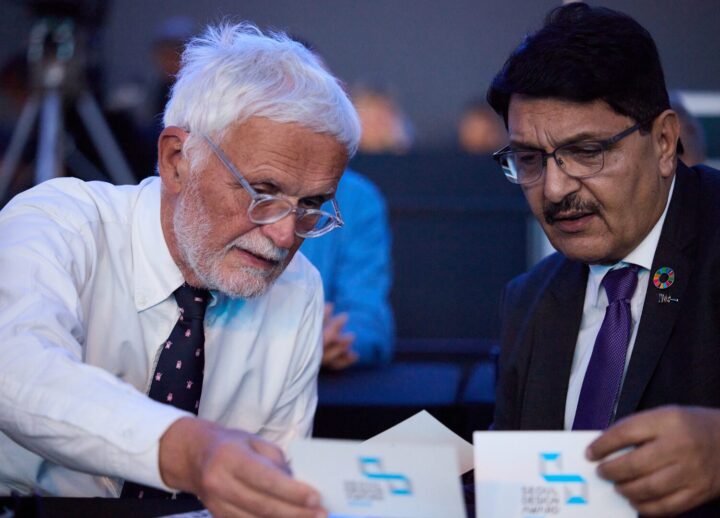
Ezio Manzini (left), who has been instrumental since the award’s inception, and this year’s jury chair, Pradyumna Vyas (right). ©Seoul Design Foundation
Jaza Energy Hubs: A Systemic Solution for Energy Equity
The Grand Prize was conferred upon Jaza Energy Hubs in Nigeria, a circular energy ecosystem that utilizes modular solar charging stations with a swappable battery rental system. Mardis Bagley, co-founder and creative director of Nonfiction Design, provided a crucial perspective during his presentation: “My 18-month residence exposed me to severe electricity shortages, which revealed that a power cut can be life-threatening. Following conversations with over 300 residents, I understood that the resource is considered as precious as gold in some areas.” Bagley stressed that the project’s core purpose transcends mere energy provision; it centers on designing a localized pathway to economic independence, granting community members charge of their future. Constructed from recycled materials, the station is easily transportable and can be erected in a day, employing basic tools to immediately begin harnessing solar energy. Users rent interchangeable battery packs, ranging from 60Ah to 180Ah, from the hubs, enhancing their quality of life by powering essential daily needs. Currently, over 500 hubs are operated nationwide by trained women designated as Jaza Stars. Jury member Ezio Manzini stated: “Jaza Energy Hubs epitomize design for social advancement, developed via a systematic process. Beyond exemplifying the possibility of uniting society and driving change, the design stands out for its careful consideration of harsh environmental conditions and outstanding aesthetics.”

A battery design inspired by the intricate motifs of Nigerian textile patterns. ©Nonfiction Design
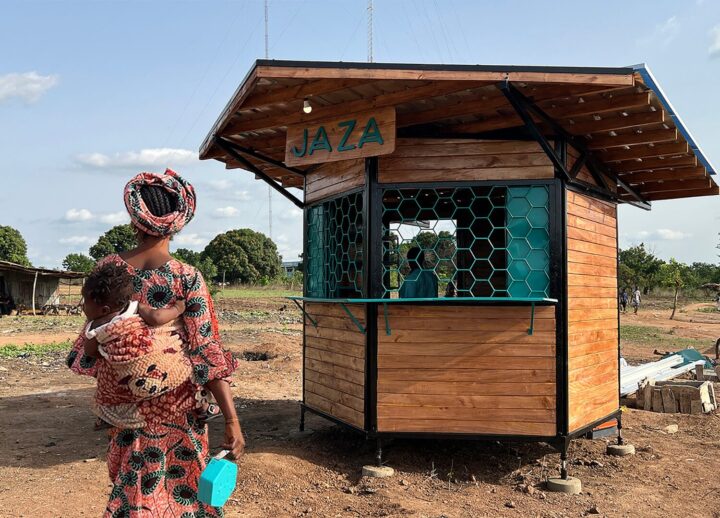
Jaza Energy Hubs foster economic independence by ensuring its entire operations are managed by women, collectively known as the Jaza Stars. ©Nonfiction Design
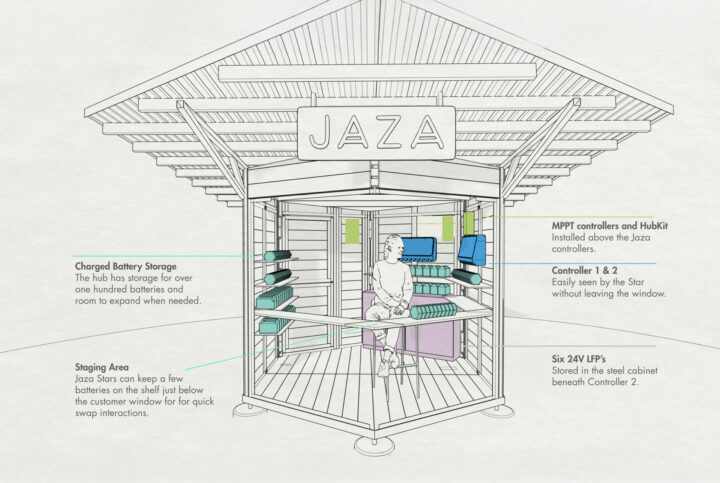
Designed for rapid, tool-free assembly, the structure features an airy interior powered by integrated solar energy. ©Nonfiction Design
LADIS LAmp DISinfection: Redefining Water Security Through Intuitive Design
Securing one of the ten finalist spots, LADIS LAmp DISinfection was acclaimed as a demonstration of how design can protect human life and dignity. Stemming from a simple mission of ‘safe water anytime, anywhere,’ the world’s first cap-type UV sterilizer maximizes user-centered simplicity by requiring only the exchange of a PET bottle cap and the press of a button. The UV light activates for three minutes, eliminating 99.9% of bacteria, and its 15,000-hour lifespan ensures virtually permanent utility. The LADIS designer and CEO of social enterprise tAB, Oh Hwan-jong, alongside designer and philosopher Kim Jang-saing, shared context on the project’s journey. Oh explained his participation in the award: “I wanted to be acknowledged for my capability at Korea’s most revered award and raise my international profile.” He continued, “I was profoundly moved by a university lecture, which served as a catalyst for me to resolve to a solution-oriented design approach, prioritizing problem-solving beyond superficial aesthetics or luxury. Subsequently, I was motivated by the locals in water-scarce countries near the equator who sterilize water with sunlight.”
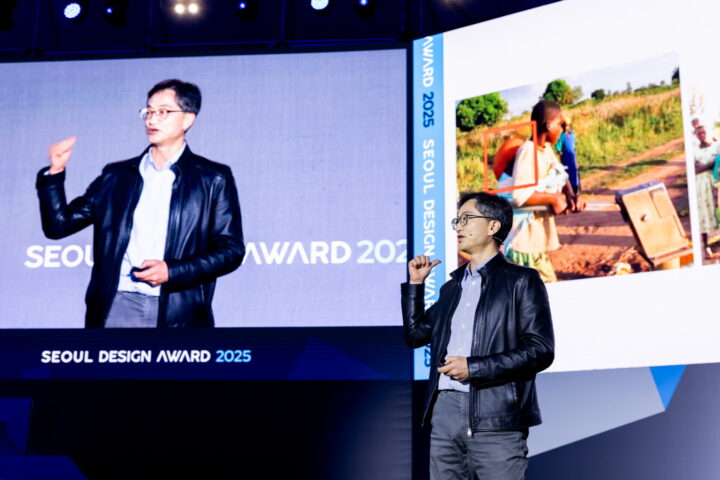
Professor Kim Jang-saing showcased LADIS LAmp DISinfection during a live presentation. ©Seoul Design Foundation
During Oh’s research, he consulted with Kim Jang-saing, who had lived in Uganda, and received practical insights. To suit local conditions, he adopted a screw-on design, inspired by the widely reused PET bottles. The measurable outcome was significant: waterborne diseases dropped by at least 58% within three months of deployment in a rural village in Laos. The UV sterilizer has expanded its application scope, reaching medical institutions, such as post-war hospitals in Ukraine. In parallel, tAB has developed a line of portable purification devices, called Spring Tap or Plop Tap. Specifically, the model adapted for the African environment utilizes bone char and paper to target the removal of arsenic and fluoride, employing micro filters. This solution offers reliable access to safe water while simultaneously creating community jobs and capitalizing on established filter replacement and subscription models. The venture is further expanding into disaster preparedness, healthcare, and the outdoor sector.

The device ensures access to safe drinking water by sterilizing the contents directly within PET bottles. ©LADIS LAmp DISinfection

This cap-type UV sterilizer employs UV-C wavelengths to eliminate harmful microorganisms. ©LADIS LAmp DISinfection
Golden Feathers: From Waste Stream to World Standard
Participating remotely via video conference, Radhesh Agrahari, the founder and director of Golden Feathers in Jaipur, India, disclosed a remarkable achievement: the development of the world’s sixth natural fiber, a material derived from upcycling the millions of tons of feather waste resulting from slaughtered chickens. The culmination of 13 years of research, this novel textile boasts up to ten times the warmth and durability compared to conventional ones, and can be processed into textiles or paper as substitutes for synthetic materials or wood. Production employs a decentralized, craft-based model that combines traditional techniques with sustainable practices. Agrahari highlighted the revolutionary economics of the approach: “While existing natural or man-made fibers cost 1,000 to 5,000 Indian rupees, these regenerated feathers can be manufactured for approximately 5 rupees per kilogram.” Furthermore, Golden Feathers has secured stable livelihoods for over 2,000 tribal women and trained more than 375 semi-skilled workers at up to twenty times the average site-specific wage.
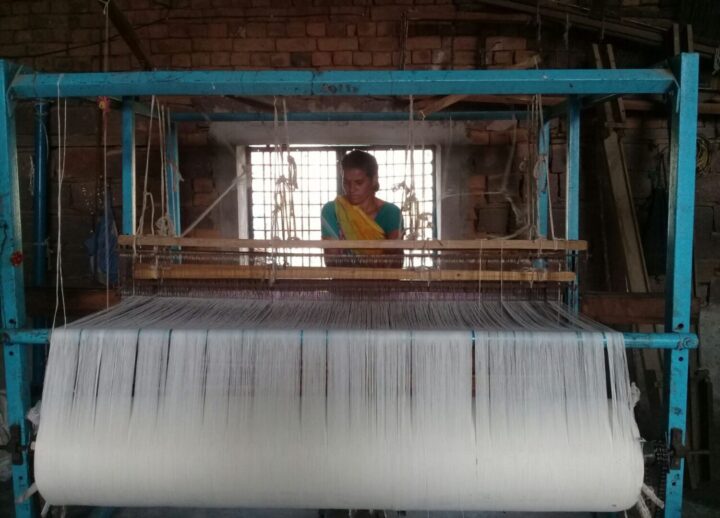
The tribal women artisans skillfully harness centuries of Indian tradition, utilizing the charkha, a spinning wheel, to craft exquisite yarn from feather wool. ©Golden Feathers
Andrea Cancellato extended high praise: “Research is the foundation of design; a principle holding more weight now than ever. Focusing on materials and detailing each element is critical. The value of the product must endure even after it is consumed. I think it deserves even a Nobel Prize.” Pradyumna Vyas, the Jury Chair and one of India’s most respected voices in design education and promotion, also commented on the project: “Amidst the urgent attention on genuine community matters, planetary resources, and regional specificity, if you have a compelling value-centric idea, this is already the basis of a breakthrough.”
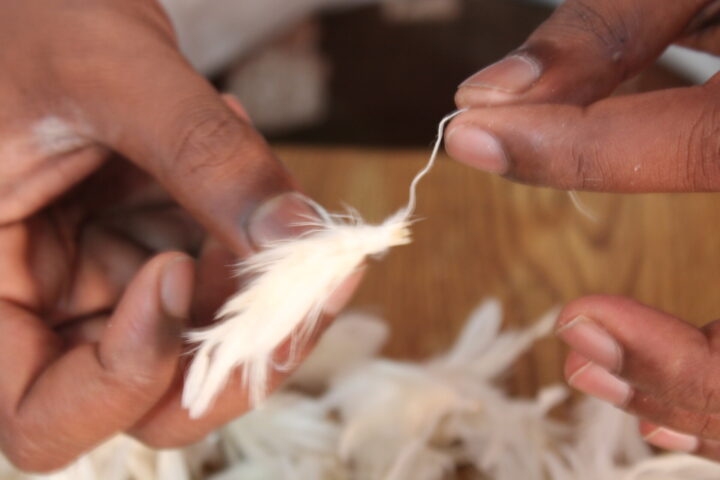
Following a 27-step natural sterilization process, chicken feather wastes sourced from local butchers are expertly sorted by skilled female artisans. ©Golden Feathers
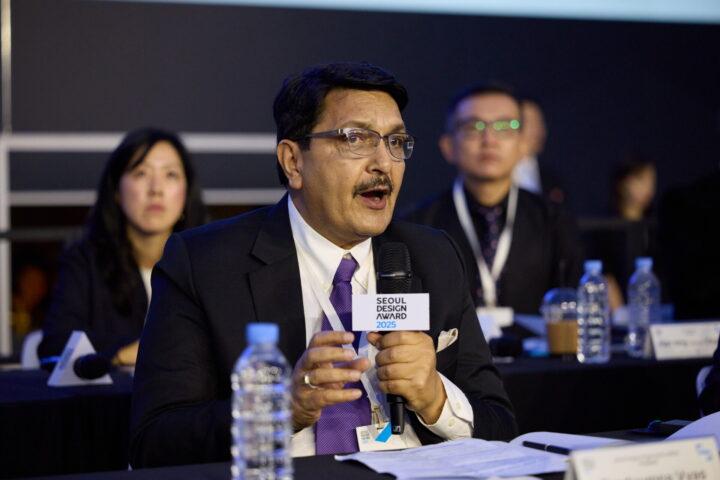
Pradyumna Vyas remarked that “Addressing localized challenges is the most authentic way to achieve a truly global resonance.” ©Seoul Design Foundation
Meanwhile, when asked how the award manages to harmonize and fairly evaluate diverse design cases under the single theme of ‘Sustainable Daily Life,’ Vyas provided insights. “Our role is to offer a clear direction concerning what complex societal challenges design must tackle. Concentrating on these local issues is essential, as they represent the true path to achieving global impact. The ability to synthesize and fairly evaluate such varied submissions stems directly from this commitment to holistic and systemic thinking.” In outlining the criteria for determining whether its entries can genuinely create sustainable social and ecological value, Tanaka Kazuo underscored the broad notion of design and implementation power. “Sustainable design should not be restricted to the narrow realm of environmental conservation, but must expand into a holistic concept that fully encompasses socio-economic aspects and human rights. From this standpoint, the relative importance of service design and conceptual design cannot be compartmentalized.” The central determinant, therefore, hinges upon the potential of a design to become a ‘real project.’ In other words, he prioritizes execution fidelity—the ability to move past offering just meaning and inspiration to achieve quantifiable results. This benchmark validates the real-world efficacy and relevance of a project in the practical sphere.
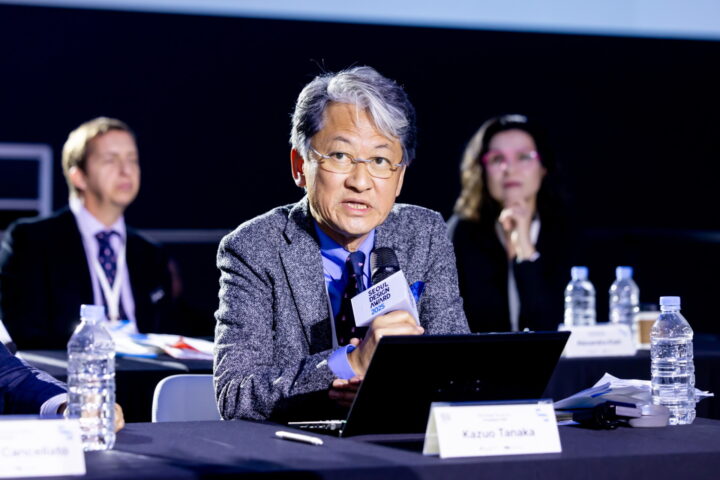
Tanaka Kazuo emphasized on-site that “True design excellence lies in the holistic integration of social values and the capacity to deliver real-world efficacy.” ©Seoul Design Foundation
Design Diplomacy: Tackling Local Societal Issues on a Transnational Stage
The remaining seven projects likewise exhibit exceptional breadth. designRESERVE introduced Desert Ark, China’s first 3D concrete-printed structure in the Tengger Desert of Alxa Left Banner, Inner Mongolia, concurrently revitalizing the desolate desert ecosystem and demonstrating the transformative potential of future architecture. The Crafted Liberation, a participatory design initiative launched by the Australian-based RK Collective in 2023, typifies a formidable instance of material transformation. Unwanted headscarves, donated by women from multiple cities, including Tehran, Eindhoven, Jakarta, and Älmhult, were integrated into the chair by being transformed into a new fiber composite, combined with recycled plastic, thus serving as a powerful medium for collective resistance and mutual objective. The Borrowing Project by Hidden-domain studio in Taiwan, which redefines temporary construction through a borrow-return mechanism, addresses the concerns of short-term, single-use waste by grounding the resource lifecycle in responsibility rather than ownership. Other notable honorees feature the Emergency Folding Cradle by the Italian social design group Anako; Soft Solids Lighting by Daydreaming Objects in Denmark, which combines upcycled lighting components with renewable natural wax blends;The City of Indigenous Arts by Estudio MMX in Mexico, which repurposes abandoned urban areas into vibrant centers for regional heritage and art; and Suomi/Koivisto Architects’s Alusta Pavilion for Multispecies Encounters in Finland, which creates an eco-friendly space designed for the coexistence of human beings and nature.
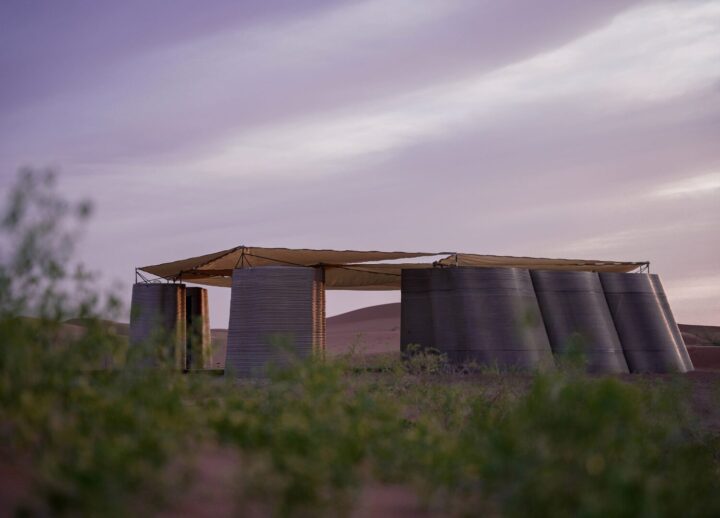
Desert Ark’s curved structure affords stability strong enough to withstand winds of up to 34 meters per second. ©designRESERVE
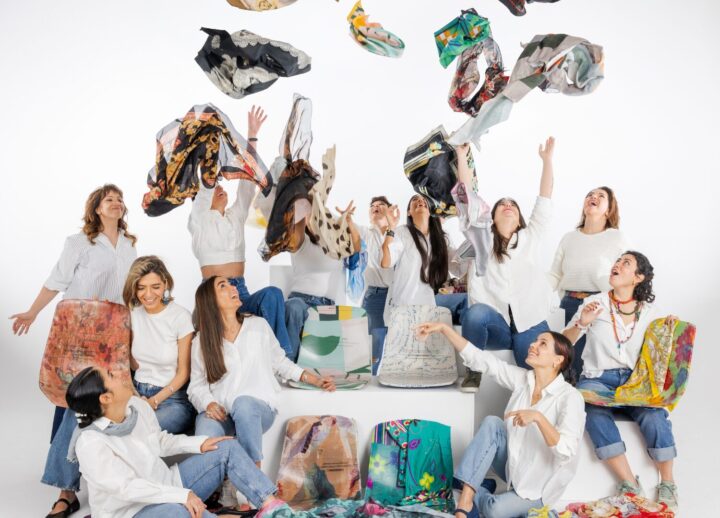
From unwanted headscarves to stadium seats, Crafted Liberation. ©Debbie Gallulo
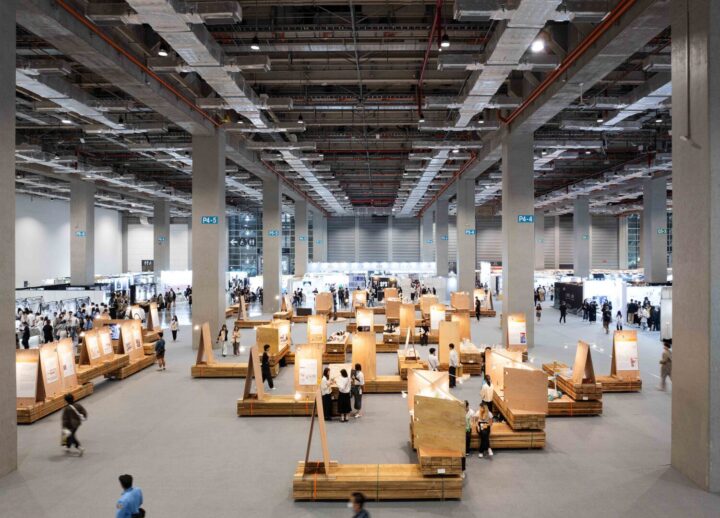
The Borrowing Project was presented at YODEX 2024, Taiwan’s largest student design exhibition, under the theme Beyond Sustainability. ©Hidden-domain studio
This tribute serves as a testament to the respect and future momentum for the innovators who inspire a healthy coexistence among people, society, and the environment. With its next session slated for 2026, the transnational platform will once again demonstrate design’s active agency in resolving planetary dilemmas.

Yoo Seoung-joo/correspondent and journalist
With two decades of expertise in the creative industry, Yoo Seoung-joo is a Paris- and Seoul-based correspondent specializing in the nexus of design, art, and culture.
Contributing to leading media across Europe and Asia, including the inaugural design publications in Japan, Korea, and France, focused on excavating timeless values that embrace both humanity and the environment.
Her 2025 highlights range from interviews with the president of E.Leclerc and a rare encounter with Ronan Bouroullec at his residence to the exclusive coverage of the World Design Congress London. She also serves as a CMF researcher and consultant for national institutions.